James E Hanson's

Constructive Math and the Continuous Degrees

Midwest Computability Seminar October 8, 2026
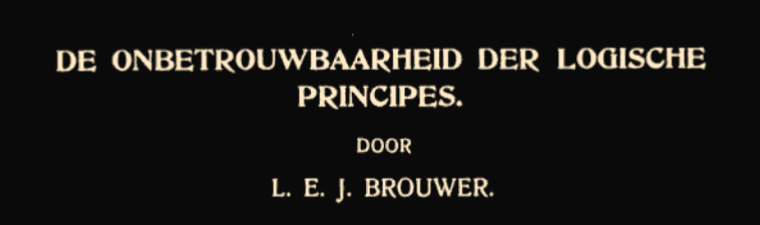
Title block of Brouwer, De onbetrouwbaarheid der logische principes

1908

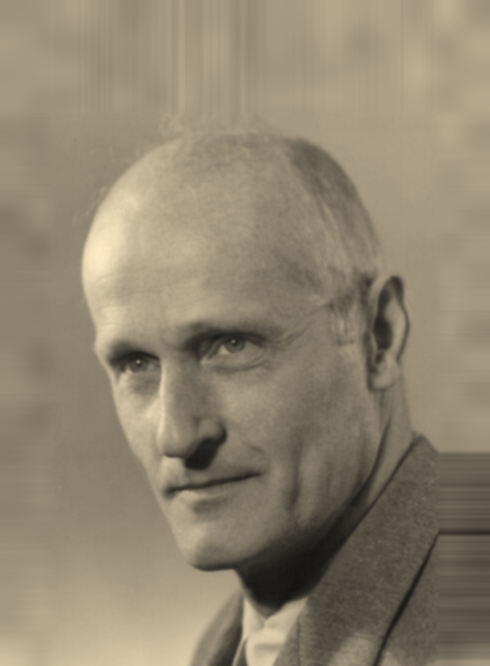
L. E. J. Brouwer
LEM
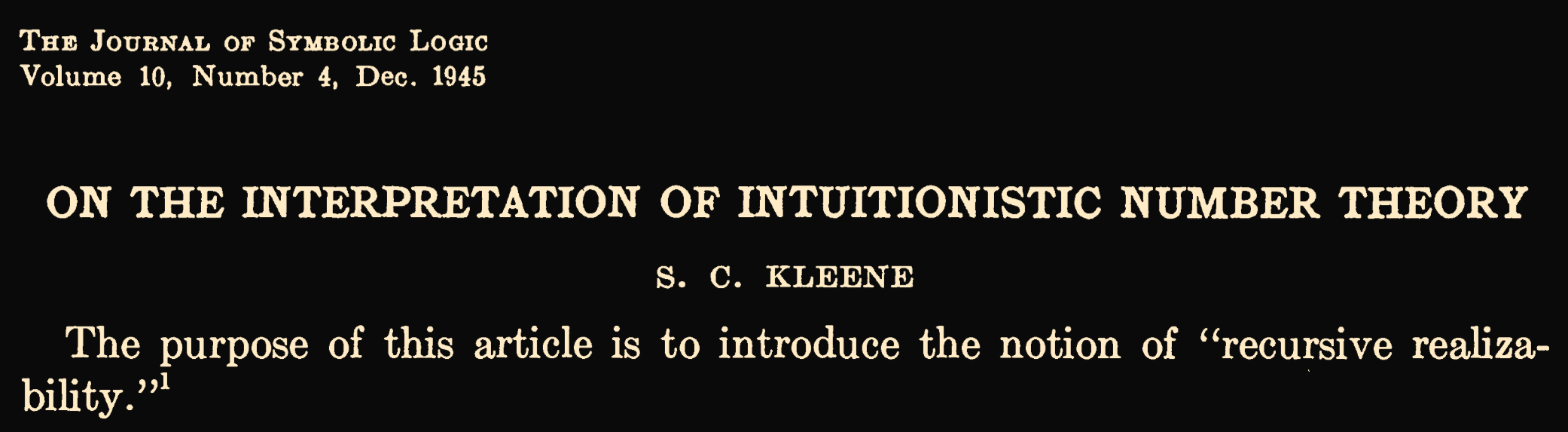
Header of Kleene, On the interpretation of intuitionistic number theory, 1945
\(\displaystyle e \Vdash \alpha \land \beta\) \(\text{iff}\) \(\displaystyle 1^{\text{st}}(e) \Vdash \alpha \land 2^{\text{nd}}(e) \Vdash \beta\)
\(\displaystyle e \Vdash \alpha \lor \beta\) \(\text{iff}\) \(\displaystyle \bigl(1^{\text{st}}(e) = 0 \land 2^{\text{nd}}(e) \Vdash \alpha\bigr)\)\(\displaystyle \lor\)\(\displaystyle \bigl(1^{\text{st}}(e) = 1 \land 2^{\text{nd}}(e) \Vdash \beta\bigr)\)
\(\displaystyle e \Vdash \alpha \to \beta\) \(\text{iff}\) \(\displaystyle \forall n\,\bigl(n \Vdash \alpha \to \varphi_e(n){\downarrow}\Vdash \beta\bigr)\)
\(\displaystyle e \Vdash \neg\alpha\) \(\text{iff}\) \(\displaystyle \forall n\,\neg(n \Vdash \alpha)\)
\(\displaystyle e \Vdash \forall x\,\alpha(x)\) \(\text{iff}\) \(\displaystyle \forall n\,\bigl(\varphi_e(n){\downarrow}\Vdash \alpha(n)\bigr)\)
\(\displaystyle e \Vdash \exists x\,\alpha(x)\) \(\text{iff}\) \(\displaystyle 2^{\text{nd}}(e) \Vdash \alpha\bigl(1^{\text{st}}(e)\bigr)\)
\(\displaystyle e \Vdash s = t\) \(\text{iff}\) \(\displaystyle s = t\)
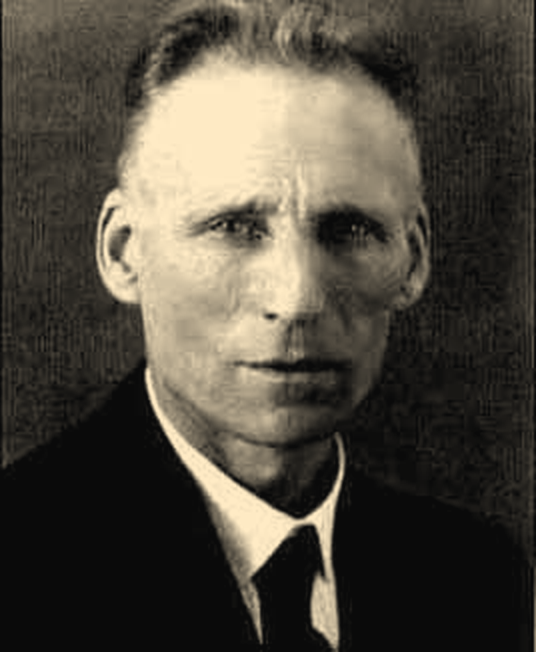
S. C. Kleene

For any sentence \(\varphi\), either \(\varphi\) is realized or \(\neg\varphi\) is realized.

LEM?

LEM

Markov's Principle (Stein's Law)

\(\displaystyle \neg\forall n\,(f(n)\neq 0)\;\to\;\exists n\,(f(n)=0)\)

Herbert Stein's congressional testimony, January 16, 1986, page 262: if something cannot go on forever it will stop.
US Congress Joint Economics Committeee hearing, January 16, 1986

Numbered sets

A (partially) numbered set is a set \(X\) together with a partial surjection \(\nu : \mathbb{N} \rightharpoonup X\).

A map \((X_0,\nu_0)\to(X_1,\nu_1)\) is a function \(f : X_0\to X_1\) and a Turing index \(e\) such that \(\nu_1(\varphi_e(n){\downarrow}) = f(\nu_0(n))\) for all \(n\) in the domain of \(\nu_0\).

Cantor wasn't wrong

Georg Cantor

\[f:\mathbb{N}\to 2^{\mathbb{N}}\]

\[g(n)=1-f(n)(n)\]

An uncountable subset of \(\mathbb{N}\)

\(\displaystyle \mathrm{Tot}=\{e\in\mathbb{N}:\varphi_e\text{ is total}\}\)

For any \(f:\mathbb{N}\to\mathrm{Tot}\), there is an \(e\in\mathrm{Tot}\) not in the range of \(f\):

\[\varphi_e(n)=1+\varphi_{f(n)}(n)\]

What is \(\mathbb{R}\)?

A realizer for \(r \in \mathbb{R}\) is a Turing index \(e\) of a (rapidly converging) Cauchy sequence limiting to \(r\).

This means that \(\mathbb{R}\) admits a surjection from a subset of \(\mathbb{N}\): \[\{e \in \mathbb{N} : e \text{ computes a Cauchy sequence}\}\]

Gives a model of constructive math \(\to\) ‘There is no surjection from a subset of \(\mathbb{N}\) onto \(\mathbb{R}\)’ is not constructively provable.

Other kinds of countable?

Can you constructively prove...

  • ...that there is no injection from \(\mathbb{R}\) into \(\mathbb{N}\)?
  • ...that there is no surjection from \(\mathbb{N}\) onto \(\mathbb{R}\)?
  • ...that there is no bijection between \(\mathbb{N}\) and \(\mathbb{R}\)?

injection \(\mathbb{R}\) into \(\mathbb{N}\) \(\to\) \(\mathbb{R}\) has decidable equality \(\to\) no surjection \(\mathbb{N}\) onto \(\mathbb{R}\)

Variants of realizability

  • (Kreisel 1957) Modified realizability adds ‘potential realizers’ in order to not satisfy Markov's principle.
  • (Bauer 2011) Ordinal-time Turing machine realizability: Injection from \(\mathbb{R}\) into \(\mathbb{N}\).

Continuous degrees

Joe Miller

(Miller 2004) Degrees for points in computable metric spaces:

\[a \leq_r b\]

iff

every name of \(b\) computes a name of \(a\)

iff

same but uniformly

Non-total continuous degrees

Kakutani's fixed-point theoremBrouwer (non-constructive) \(\to\) There is a \(\mu\in[0,1]^{\mathbb{N}}\) such that if \(\varphi_e^p\) computes a fixed element of \([0,1]\) for all names \(p\) of \(\mu\), then that element is \(\mu(e)\).

Smells like a surjection from \(\mathbb{N}\) onto \([0,1]\)

“A long time ago, the Japanese mathematician Kakutani asked me why so many economists had attended the lecture he had just given. When I told him that he was famous because of the Kakutani fixed-point theorem, he replied, ‘What is the Kakutani fixed-point theorem?’” -Ken Binmore

Parameterized realizability

Fix a nonempty set of oracles \(\mathbb{P}\subseteq 2^{\mathbb{N}}\).

\(\displaystyle e \Vdash \alpha \land \beta\) \(\text{iff}\) \(\displaystyle 1^{\text{st}}(e) \Vdash \alpha \land 2^{\text{nd}}(e) \Vdash \beta\)
\(\displaystyle e \Vdash \alpha \lor \beta\) \(\text{iff}\) \(\displaystyle \bigl(1^{\text{st}}(e) = 0 \land 2^{\text{nd}}(e) \Vdash \alpha\bigr)\)\(\displaystyle \lor\)\(\displaystyle \bigl(1^{\text{st}}(e) = 1 \land 2^{\text{nd}}(e) \Vdash \beta\bigr)\)
\(\displaystyle e \Vdash \alpha \to \beta\) \(\text{iff}\) \(\displaystyle \forall p\in\mathbb{P}\;\forall n\,\bigl(n \Vdash \alpha \to \varphi_e^p(n){\downarrow}\Vdash \beta\bigr)\)
\(\displaystyle e \Vdash \neg\alpha\) \(\text{iff}\) \(\displaystyle \forall n\,\neg(n \Vdash \alpha)\)
\(\displaystyle e \Vdash \forall x\,\alpha(x)\) \(\text{iff}\) \(\displaystyle \forall p\in\mathbb{P}\;\forall n\,\bigl(\varphi_e^p(n){\downarrow}\Vdash \alpha(n)\bigr)\)
\(\displaystyle e \Vdash \exists x\,\alpha(x)\) \(\text{iff}\) \(\displaystyle 2^{\text{nd}}(e) \Vdash \alpha\bigl(1^{\text{st}}(e)\bigr)\)
\(\displaystyle e \Vdash s = t\) \(\text{iff}\) \(\displaystyle s = t\)

Parameterized numbered sets

Fix a nonempty set of oracles \(\mathbb{P}\subseteq 2^{\mathbb{N}}\).

A parameterized numbered set is a set \(X\) together with a partial surjection \(\nu : \mathbb{N} \rightharpoonup X\).

A map \((X_0,\nu_0)\to(X_1,\nu_1)\) is a function \(f : X_0\to X_1\) and a Turing index \(e\) such that \(\nu_1(\varphi_e^p(n){\downarrow}) = f(\nu_0(n))\) for all \(p\in\mathbb{P}\) and all \(n\) in the domain of \(\nu_0\).

What is \(\mathbb{R}\) this time? Countable

Fix \(\mu \in [0,1]^{\mathbb{N}}\). Let \(\mathbb{P}\) be the set of names of \(\mu\).

A realizer for \(r \in \mathbb{R}\) is an index \(e\) that computes a Cauchy sequence of \(r\) from any \(p \in \mathbb{P}\). Note that the sequence can depend on \(p\).

\(\mu : \mathbb{N} \to [0,1]\) is surjective ‘in the sense of realizability’: There is a program that, for any realizer \(e\) of \(x \in [0,1]\), computes an \(n\) such that \(\mu(n) = x\) (using any given \(p\) as an oracle).

(It's just the identity map. Doesn't even use \(p\).)

\(f(n) = 1^{\mathrm{st}}(n) \cdot (\mu(2^{\mathrm{nd}}(n)) - \frac{1}{2})\) is a surjection from \(\mathbb{N}\) onto \(\mathbb{R}\).

What can you prove?

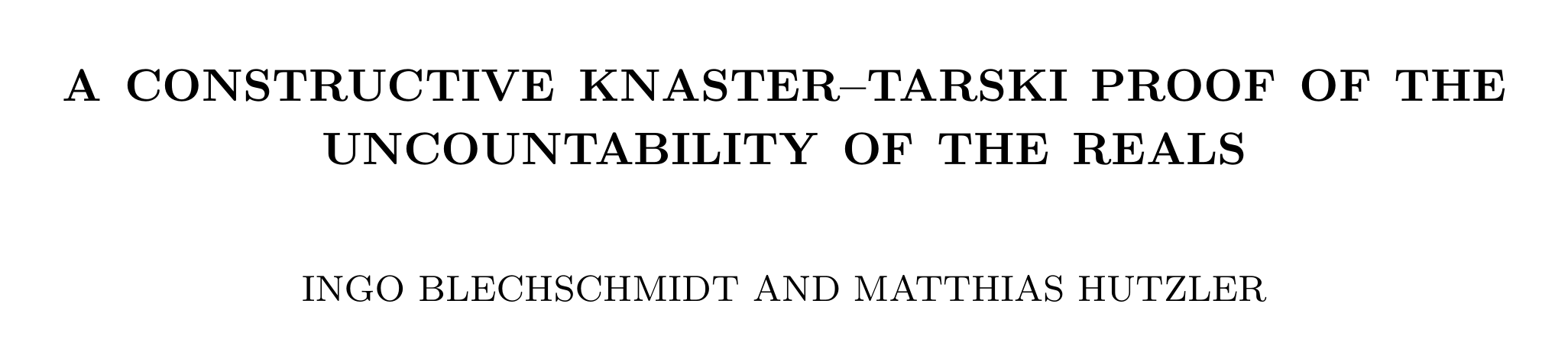
A constructive Knaster–Tarski proof of the uncountability of the reals — Ingo Blechschmidt and Matthias Hutzler
2019

Corollary: For any \(f : \mathbb{N} \to [0,1]\), there is a nonempty set \(X \subseteq [0,1]\) such that for each \(n\), \(f(n)\) is not the supremum of \(X\).

(me) For any \(f : \mathbb{N} \to [0,1]\), there is a non-decreasing \(g : \mathbb{N} \to [0,1]\) such that for each \(n\), \(f(n)\) is not the supremum of \(g\).

Thank You

Loading…